Get Grooven At A Glance
- Smart building technology for hotels connects systems like heating and cooling, lighting, and equipment sensors so staff can monitor and adjust them from one place.
- Hotels spend about 6 percent of their operating costs on energy, with heating and cooling making up almost 40 percent of a typical hotel’s electricity use.
- Occupancy-based controls let unsold or empty rooms rest at an energy-saving temperature, then bring them back to comfort before guests arrive.
- Remote alerts help a lean maintenance team catch equipment problems early, often before a guest notices anything is wrong.
- Most hotels can start with one system, such as energy management or smart lighting, and add more as the property’s needs grow.
Why Smart Building Technology Matters for Hotel Operations
Half of hotel owners now name utility and energy costs as a top financial pressure, according to a March 2026 American Hotel and Lodging Association (AHLA) survey. More than half of the hoteliers in that same survey said their properties are somewhat or severely understaffed. Put those two numbers together and a familiar picture comes into focus: general managers are being asked to run tighter buildings with fewer hands.
In many cases, hotels can ease that pressure by adjusting things that have no effect on guests or staff at all. Guest rooms sit heated or cooled while nobody is in them. Hallway lights burn at full brightness at 3 a.m. An air conditioning unit starts struggling on a Friday night, and nobody knows until a guest calls the front desk.
Smart building technology gives those background systems a way to report in and adjust on their own. This post explains what that looks like in a hotel, where the energy and labor savings come from, and how to get started without overhauling the whole property.
What Smart Building Technology Means for a Hotel
Guest-facing tools like Wi-Fi and in-room entertainment shape the hotel guest experience in ways people notice right away. Smart building technologies work one layer down, keeping the building comfortable, efficient, and predictable behind the scenes.
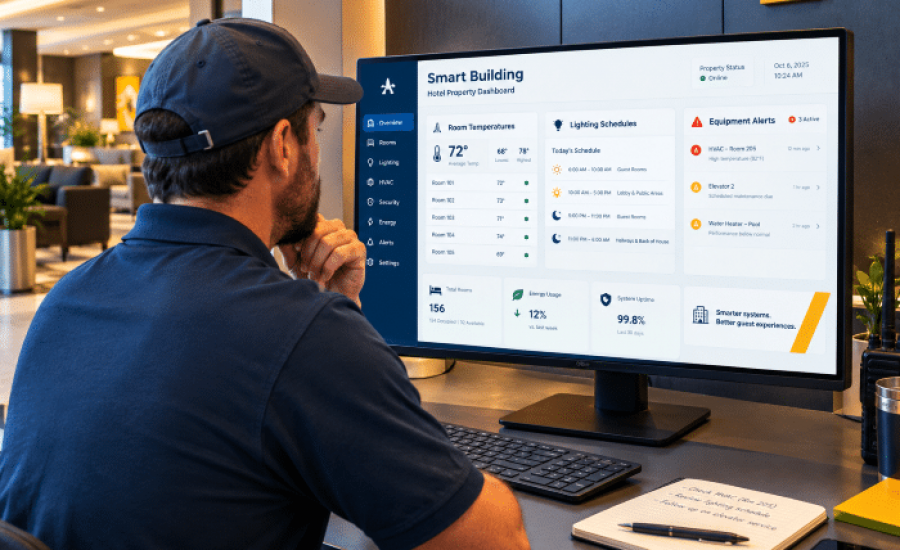
Smart building technology for hotels is a set of connected sensors, controls, and software that lets a property monitor and automate its building systems, typically heating and cooling, lighting, and key equipment. Staff can check status, change settings, and receive alerts from a single dashboard, which saves a lot of trips around the building.
Cutting Energy Waste in Rooms Nobody Is Using
According to ENERGY STAR, the roughly 47,000 hotels and motels in the United States spend about 6 percent of their operating costs on energy. Heating and cooling account for almost 40 percent of a typical hotel’s electricity use. Yet many properties condition rooms around the clock, even though studies cited by ENERGY STAR show hotel rooms sit empty about 12 hours a day on average.
Occupancy-based energy management controls close that gap. When a room is unsold, the system holds it at an energy-saving setback temperature. Shortly before a guest arrives, the room comes back to a comfortable setting. Once guests are inside, they still control their own thermostat.
ENERGY STAR estimates that an energy management system tied to a hotel’s reservation and check-out systems can lower energy costs by 35 to 45 percent. Results vary by building, climate, and existing equipment, so it helps to treat that range as a best-case benchmark. Smart thermostats are usually the starting point for energy management in a hotel, since guest rooms make up most of the conditioned space.
Smart Lighting for Hallways, Back-of-House & Parking Areas
ENERGY STAR also reports that lighting uses almost a quarter of the electricity in a typical hotel. Much of that load sits in spaces that run around the clock, like corridors, stairwells, back offices, and parking areas.
Smart lighting uses occupancy sensors, schedules, and dimming to match light levels to actual use. A hallway can dim when it is empty and brighten the moment someone steps off the elevator. Laundry rooms, storage areas, and meeting rooms can switch off on their own when nobody is inside. Fewer burn hours also means fewer bulbs to replace, which trims a small but steady maintenance task.
Inside guest rooms, smart lighting can improve the guest experience with simple scene controls. In back-of-house spaces, the savings tend to show up first on the utility bill.
Giving a Lean Team Fewer Things To Chase
With so many hotels short-staffed, every manual check carries a real cost. Walking floors to confirm thermostat settings, resetting lights after events, and checking mechanical rooms all pull time away from guests and preventive work.
Smart building technology moves much of that checking onto a screen. An engineer or general manager can see room temperatures, lighting schedules, and equipment status from a laptop or phone. Settings for a wing, a floor, or a single room can change in seconds. During slow stretches, a property can also set back entire floors that are not in use, a strategy ENERGY STAR recommends for periods of low occupancy.
The point is to help the team you already have cover more ground. A maintenance lead who spends less time on routine rounds has more time for the repairs and upkeep that guests actually see.
Catching Equipment Problems Before Guests Do
A struggling heating and cooling unit rarely fails all at once. Instead, it runs longer, cools less, or cycles in odd patterns for days before a guest finally calls about a warm room. Connected sensors can flag those patterns early and send an alert to the right person.
Early alerts turn a late-night emergency into a scheduled repair. They also protect online reviews, because a room that stays comfortable never turns into a complaint. Remote troubleshooting helps too, since many issues can be diagnosed without a technician driving to the property. That matters most at a select-service hotel where one maintenance lead may cover the entire building.
How Smart Building Systems Fit With the Rest of Your Hotel Technology
Smart building systems usually ride on the same network that carries guest Wi-Fi, phones, and in-room entertainment. As a result, the network’s reliability affects everything connected to it. The number of companies involved matters as well. When thermostats, lighting, Wi-Fi, and TV each come from a different provider, one problem can turn into a round of finger-pointing, and hotel technology vendor sprawl adds cost and confusion over time.
Electric vehicle (EV) charging is another system that often connects to the same network. Connected chargers let staff track usage and availability remotely, and they give road-tripping guests one more reason to book.
Where To Start With Smart Building Technology at Your Hotel
Most hotels get the best results by starting small and building from there. These four steps keep the first project focused.
1 – Look at Your Utility Bills First
Your energy bills show where the money goes. Heating, cooling, and lighting usually lead the list, which makes them natural first projects.
2 – Check Your Network and Wiring
Smart building systems depend on a solid network. Older properties can often reuse existing wiring through retrofit solutions, which helps avoid opening walls.
3 – Pick One System and Measure It
Start with energy management or smart lighting in one area. Track the before and after for a few months, then expand to other floors or systems.
4 – Decide Who Watches the Alerts
Alerts only help when someone acts on them. Decide whether your team, a managed service provider, or both will respond, and during which hours.
Frequently Asked Questions About Smart Building Technology for Hotels
Yes, most older hotels can add smart building technology without a major renovation, because wireless thermostats, sensors, and lighting controls fit into existing rooms, and retrofit networking equipment can often run over a property’s existing coaxial or phone wiring, so installation usually happens room by room while the hotel stays open. A site survey shows which wiring can be reused and where new cabling makes more sense.
Guests keep control of their room temperature in a typical smart building setup, because occupancy-based controls only step in when a room is unsold or empty, and once guests are inside they can adjust the thermostat as usual, while the system returns the room to an energy-saving setting after check-out or after the guest has been away for a set period. Most guests never notice the system at work.
Smart building technology helps hotels manage staffing shortages by cutting the routine checks that fill a maintenance team’s day, such as walking floors to confirm thermostat settings or resetting lights after events, and by sending alerts so a small team can respond to real problems as soon as they appear. It works best as support for the people already on staff. With more than half of hoteliers reporting understaffing in AHLA’s 2026 survey, those saved hours add up quickly.
Making Hotel Operations Easier Behind the Scenes
Smart building technology works quietly in the background of a hotel. It trims energy waste in empty rooms and corridors, gives a short-staffed team more reach, and flags equipment trouble before it reaches a guest. Most properties can start with one system and grow from there.
At Groove Technology Solutions, helping hotels put these systems to work is everyday work for us. We design, install, and support smart building technology alongside the Wi-Fi, TV, phone, and security systems that hotels across the country already rely on. That means one team to call when something needs attention. Our work is backed by the Groove Guarantee and thousands of five-star reviews.
If you are curious what smart building technology could look like at your property, we are happy to talk it through whenever the timing works for you. Feel free to reach out to us with any questions.

