Get Grooven At A Glance
- Cellular amplification captures the outdoor cell signal and rebroadcasts it inside a senior living community to improve cellular coverage in resident rooms, hallways, and lower levels.
- Most adults 65 and older own a smartphone, making reliable indoor cellular coverage an important consideration for senior living communities.
- Dead zones in senior living communities often show up in memory care wings, lower-level dining rooms and therapy spaces, elevators, and windowless common areas.
- Care staff rely on cell coverage to return family calls, receive alerts, and stay reachable anywhere on the property.
- A cellular amplification project works best when it starts with a carrier-by-carrier signal survey and schedules installation around residents’ daily routines.
Why Cell Signal Matters in Senior Living Communities
Cellular phones are now a normal part of daily life for older adults. According to the Pew Research Center, 95 percent of adults 65 and older own a cell phone. For many residents, that phone is how they talk to grandchildren, check in with doctors, and call for help.
Unfortunately, large senior living buildings can make reliable cellular reception difficult. Bigger footprints, long interior corridors, and lower-level spaces all weaken the signal coming from nearby towers. As a result, residents have to step outside to finish a call while caregivers must wait until a break to return a message.
Cellular amplification captures an existing outdoor cellular signal and distributes it indoors through a system designed to improve coverage in targeted areas. This guide covers where dead zones tend to appear, how weak signal affects residents and staff, and how to plan a project that fits daily life in your senior living community.
Where Senior Living Dead Zones Tend To Show Up
Dead zones in a senior living community often occur in predictable areas of large buildings. Most of them share one trait: distance from an exterior wall or window.
- Memory Care Wings – These secured areas may sit deeper inside the building for safety reasons. That layout can make indoor cellular coverage more challenging.
- Lower Levels – Dining rooms, therapy gyms, and staff break rooms on garden or basement levels lose signal through the surrounding soil and concrete.
- Elevators and Stairwells – Steel shafts can block signals, so calls tend to drop between floors.
- Interior Common Areas – Chapels, theaters, and dining rooms at the center of a building with no windows tend to have weak reception.
- Back-of-House Spaces – Kitchens, laundry rooms, and mechanical rooms are full of metal equipment that weakens reception for the staff who work there.
Building materials play a large role too, much like the blocked signals in healthcare buildings that hospitals deal with. Renovations can also change indoor cellular coverage. Certain energy-efficient windows, insulation systems, and construction materials can attenuate radio signals, depending on their composition and design. While it helps to rule out simple coverage fixes for poor reception, chronic cell phone signal issues in the same area tend to warrant cellular amplification services.
How Weak Cell Signal Affects Senior Living Residents
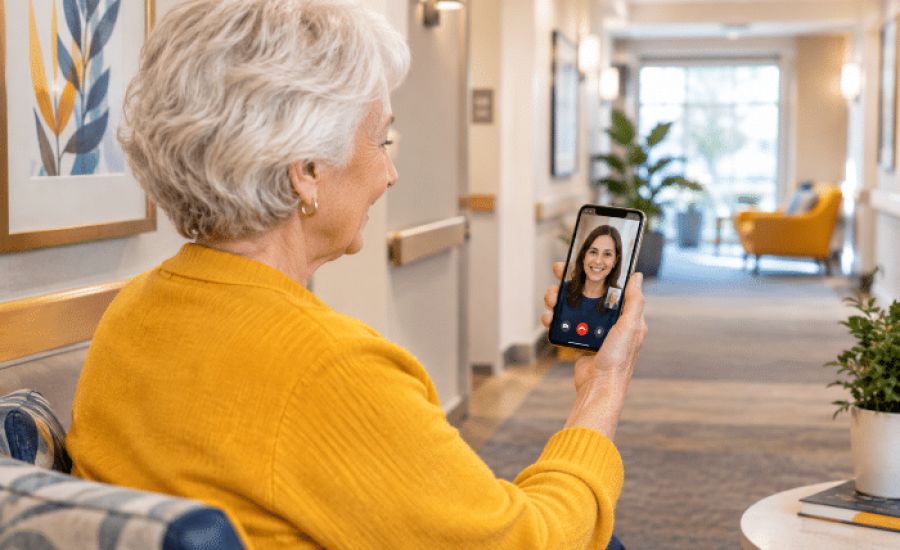
For residents, a weak cell signal shows up in small, frustrating ways every day. A video call with a grandchild freezes halfway through. A telehealth appointment drops, so the resident has to reschedule. Meanwhile, a phone that struggles to maintain a connection may use more battery power, which is an inconvenience for residents and guests.
Wireless phones account for a substantial share of 911 calls, making indoor cellular coverage an important consideration for resident and staff communications. A weak signal can interfere with a call, although actual performance depends on the device, network availability, and location. Communities should not treat cellular amplification as a substitute for their established emergency communication procedures.
Families notice the gaps as well. When a resident’s children can’t reach a parent, they often call the front desk instead. That worry ultimately shapes how they feel about the community. Prospective residents also check their phones during tours, so a dead zone can quietly become part of a first impression.
How Weak Cell Signal Affects Care Staff and Daily Operations
Care teams depend on cell coverage just as much as residents do. Many communities now give caregivers smartphones for secure messaging, care documentation, and alerts from nurse call or monitoring systems. When those phones lose signal in a hallway, an alert runs the risk of arriving late.
Staff also return calls from families throughout a shift. In a dead zone, that call waits until the caregiver steps outside, which pulls them away from residents. Similarly, maintenance techs and dietary staff run into the same problem in mechanical rooms and kitchens.
Many staff devices can fall back on Wi-Fi, which helps. Pairing cellular amplification with managed Wi-Fi can provide additional connectivity options for compatible devices and applications. Wi-Fi calling and other network-dependent services must be supported and configured correctly, so communities should verify how critical communications will function during a cellular or internet outage.
What Cellular Amplification Does for a Senior Living Community
Cellular amplification is a system that captures the existing cell signal outside a building, strengthens it, and rebroadcasts it through indoor antennas. In a senior living community, that means dependable calls, texts, and mobile data in resident rooms, memory care wings, lower levels, and common areas.
The primary parts of a cellular amplification system stay the same across property types, with a few features emphasized more in senior living.
- Multi-Carrier Coverage – Residents, families, and staff may use different carriers. The site survey should identify the carriers and frequency bands that need support, and the system design should account for those requirements.
- Low-Profile Antennas – Indoor antennas mount on ceilings alongside smoke detectors and Wi-Fi access points, which keeps hallways feeling residential.
- Room To Grow – A design that leaves space for added carriers or new wings saves a community from starting over later.
- A Separate Public Safety System – Cellular amplification supports everyday phones, while a public safety distributed antenna system (DAS) supports first responder radios and follows local fire code.
How To Plan a Cellular Amplification Project in Senior Living
Cellular amplification is a professional installation from the first site visit through long-term monitoring. Knowing what a qualified provider handles at each stage helps directors and owners compare proposals and set clear expectations with residents and staff.
1 – A Discovery Conversation With Your Team
A good provider starts by asking where calls drop and who feels it most. Front desk staff, caregivers, and residents usually know the trouble spots well, and their reports should point the survey team to the right wings.
2 – A Carrier-by-Carrier Signal Survey
Next, the provider will measure coverage for each major carrier across the whole property, inside and out. One carrier may work well in a wing where another drops completely, so a survey that checks every carrier should show the real gaps.
3 – A System Design Built Around the Building
Using the survey results, the provider will design a system that fits the property’s outdoor signal strength, size, and number of floors. System design depends on the building’s size and layout, available outdoor signal, required coverage, supported carriers and frequency bands, and performance goals. A qualified provider can use survey results to determine whether a passive, active, or other system architecture is appropriate. Understanding the cellular amplification options behind these choices should make the proposals easier to compare.
4 – Carrier Coordination and Installation Planned Around Residents
The provider will then coordinate with carriers and install carrier-approved hardware. Crews will then work in ceilings, hallways, and mechanical spaces, scheduling around mealtimes, quiet hours, and memory care routines to keep disruption low.
5 – Testing and Ongoing Monitoring
After installation, the provider will test coverage again to confirm every area performs as designed. Carrier networks change over time, so ongoing monitoring catches problems before residents notice them.
When comparing providers, it helps to ask whether one team handles all five stages or whether the work gets split among several subcontractors.
Frequently Asked Questions About Cellular Amplification in Senior Living
Cellular amplification may improve connectivity for medical alert devices that use a supported cellular network. However, not all medical alert systems rely on cellular service, and compatibility depends on the device, carrier, and amplification system. Before installation, check which network the device uses and confirm that the proposed system supports it. Communities should also maintain appropriate emergency response procedures rather than relying on improved cellular coverage alone.
Installing cellular amplification in an occupied senior living community is often less disruptive than staff expect, since most of the work happens in ceilings, hallways, rooftops, and mechanical spaces. Crews run cable above ceilings and mount small antennas, which usually means short visits to each area. Project length will depend on building size and design, so a site survey gives the clearest timeline.
No, they are not the same. Cellular amplification improves commercial cellular service for residents and staff. Public safety DAS or another approved in-building emergency responder communication system supports first responder radio communications where required by applicable codes and local authorities. The systems serve different purposes, and the need for each should be determined during project planning.
Bringing Reliable Cell Coverage to Every Corner of Your Community
A weak cell signal affects nearly everyone in a senior living community. Residents miss calls from family, caregivers wait to return messages, and families worry when they can’t get through. Cellular amplification helps elevate the technology at your assisted living community, helping extend cellular coverage to resident rooms, lower levels, and other areas with weak reception.
Planning and installing cellular amplification systems is a service we specialize in at Groove Technology Solutions. We survey each property carrier by carrier, design around the building and the people who live there, and keep an eye on the system long after installation. Our Groove Guarantee and thousands of five-star reviews reflect how we treat every senior living community we work with.
If dead zones are getting in the way for your residents and staff, we’re happy to talk it through. Feel free to reach out to us whenever the timing works for you.

