Get Grooven At A Glance
- AI-powered search lets staff find footage in seconds instead of scrubbing through hours of recordings.
- Pairing cameras with access control confirms who actually used a credential, not just that one was used.
- Facial recognition works best as a secondary confirmation for flagging known concerns, not as a primary way to unlock doors.
- Edge-based storage means one failed camera does not take down footage for a whole group of cameras.
- Live video now integrates directly into Della OS, cutting down on separate logins.
For years, video surveillance meant cameras recording footage that someone might review later, usually after something had already gone wrong. Today, thanks to new technology and the use of artificial intelligence, video surveillance has changed from a passive record-keeping tool into an active system that helps property staff search, monitor, and respond in real time. For property managers and owners, where safety and liability carry real weight, that shift has been critical to providing safe and secure properties.
This article explores how AI video surveillance technology continues to transform how commercial properties operate for safety, along with some real insights from our experts on the ways video surveillance should fit into your larger PropTech strategy.
The Property Technology Pyramid
Most properties, regardless of size or industry, end up relying on the same core set of intertwined technologies. That’s where the property technology pyramid comes in.
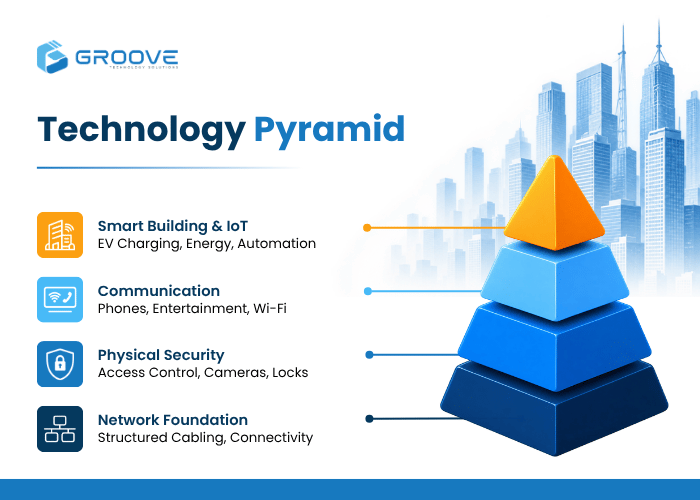
“I always tell properties to think of their technology like a pyramid because it puts the baseline in perspective. Network, security, and communications are the bottom three tiers, and almost every property has those in some form. Smart building features and IoT sit on top of that, but the pyramid reminds you that none of it works well without a strong baseline underneath it.”
– AJ Pierson, SME of Access Control at Groove
Network infrastructure and structured cabling form the base. As the layer that everything else depends on, nearly every property has some version of it in place. Physical security builds on top of that, covering access control, cameras, locks, and intercoms. These systems typically share the same underlying network and therefore tend to get planned and installed together rather than as separate projects. Artificial intelligence has increasingly become part of this tier as well, giving cameras and access control systems the ability to search footage, flag activity, and alert staff in ways that were not possible even a few years ago. Communications follows next, covering phone systems and the data infrastructure that supports them. Smart building features and IoT, such as EV charging and building automation, sit at the top. These solutions typically solve for convenience and efficiency specific to a building’s individual needs.
This pyramid is a great illustration as to why video surveillance rarely makes sense as a standalone purchase. It sits within that second tier, alongside access control and other physical security systems, all of which are built on the same network foundation. Understanding that layered structure helps clarify why planning these technologies as a single connected system rather than acquired piece by piece helps properties run more efficiently and effectively.
Cameras Work Best as Part of a Connected System
As the property technology pyramid shows, video surveillance rarely functions best as a standalone product. On its own, a camera system can show what happened, but it cannot always confirm who was involved. That is where pairing cameras with access control makes a real difference. Access control tells staff which credential was used to open a door and when. A camera paired with that same door tells staff who was actually holding it. Together, the two systems give property staff a much more reliable picture of who was actually moving through a building instead of just a record of which credential was used. The distinction becomes especially important in an incident review when confirming identity matters more than verifying just that a door was opened.
AI-Powered Search Cuts Review Time to Seconds
Reviewing security footage used to mean sitting through hours of recordings to find one moment. AI-powered search has largely solved that problem. Staff can now search recorded footage by descriptive detail, such as what someone was wearing, instead of scrubbing through a timeline frame by frame.
“You can search for things like the color of a shirt, a hat, almost any detail you remember, and it pulls up every camera and feed that captured it. Security staff are no longer stuck reviewing hours of footage just to find one moment.”
– Andres Olvera, SME of Wi-Fi and Networks at Groove
The time savings add up quickly for property staff who are already managing dozens of other responsibilities. For instance, AI security cameras for properties can now flag a car that has been parked in the same spot for a long time, prompting staff to check on it rather than noticing it days later during a routine walk-through. The same detection capability can confirm that people coming and going through an entrance are residents, staff, or authorized visitors, flagging anyone lingering near an entrance who does not fit that pattern. Facial recognition can also alert staff in real time if someone previously trespassed on the property returns, before a guest or resident would need to report them for trespassing.
Some newer systems take this a step further by connecting exterior camera feeds to the National Crime Information Center database. AI video surveillance cameras positioned in parking areas can read license plates, and if a vehicle matches a stolen car or is tied to someone with a relevant criminal history, the match is flagged and shared with local police through that law enforcement partnership, without the property needing to take any action itself.
A Measured Take on Facial Recognition
Facial recognition gets a lot of attention in AI security cameras for properties right now. However, it is worth being precise about how it is actually being used. While the technology has come a long way, property managers should still be hesitant to rely on it for unlocking doors. Ultimately, physical credentials remain a more secure and stable method of access over facial recognition alone. Experts in this space see facial recognition as a secondary confirmation rather than a primary access method. A resident or staff member should still have to present a physical credential to open a door with the AI simply confirming that the right person is there.
“Facial recognition has come a long way, but I’ve seen how easily it can still be tricked. There are masks out now, mesh material printed with someone’s actual facial features, that are realistic enough to fool the software. That is part of why I don’t think it’s ready to be used as the thing standing between someone and a locked door. It works well right now as a secondary check, but not as the only line of defense.”
– AJ Pierson, SME of Access Control at Groove
Ultimately, though AI continues to drive innovation with security, for now where facial recognition truly stands out is in flagging individuals who have already been identified as a concern. For instance, sending an alert for someone who has trespassed on the property before, so staff can be alerted if that person returns.
Smarter Storage Means Fewer Points of Failure
The rise of AI video surveillance has also pushed storage architecture to evolve. Running search and detection directly on a camera works best when not dependent on a shared, centralized system. Traditional systems relied on a single network video recorder, where many cameras fed into one shared hard drive. If that drive failed, every camera tied to it lost its footage, along with anything recorded. Newer edge-based AI surveillance cameras solve that single point of failure by storing footage locally on a microSD card built into each unit. If one card fails, only that camera is affected. Fixing it is as simple as swapping the card and moving on. That change alone significantly reduces the operational risk of a hardware failure for properties running larger camera systems.
One Platform, One View with AI Surveillance
Perhaps the most practical shift for day-to-day property management is how AI-enabled surveillance now connects to broader property software. Rather than requiring a separate login and credentials just to check a camera feed, staff view live video with ease. In addition, they see the alerts and flags directly within Della OS, the same platform used to manage daily operations.
That means a leasing agent or community staff member who does not have full camera system access can still glance at what is happening on the property in real time without needing a separate set of credentials. For a property manager juggling multiple systems already, one fewer login makes a meaningful difference.
Building a Camera System That Works Together
Video surveillance has come a long way from a camera pointed at a hallway. AI is what makes today’s systems search, flag, and alert on their own, working best when connected directly into the rest of a property’s security and management systems rather than running in isolation. That shift means fewer blind spots, faster answers when something needs to be reviewed, and a system that actually supports the people managing these communities day to day.
The best surveillance for commercial properties rarely works well as a one-size-fits-all package. Every system is designed for a property’s layout, concerns, and feedback instead of standard cameras placed the same way every time. Customized designs and system integration also solve a problem many properties do not realize they are dealing with.
“All too often at a property you have someone managing the network, someone else managing physical security, and another vendor handling phones and guest Wi-Fi. That means three or four different phone numbers, and because it all ties back to the same network in the end, there is a lot of finger-pointing when something goes wrong. What Groove does differently is manage all of it ourselves, so a property has one team and one number to call, no matter which part of the system needs attention.”
– Andres Olvera, SME of Wi-Fi and Networks at Groove
Groove designs, installs, and maintains video surveillance systems around each property’s specific needs as part of a connected security ecosystem. If you are evaluating your property’s current camera setup or planning a new system from the ground up, reach out to Groove today to talk through what a connected solution could look like for your multifamily or senior living community.