Get Grooven At A Glance
- Cloud-based access control runs through internet-connected software so staff can manage doors, gates, and credentials from a phone or computer, while traditional systems rely on an on-site panel wired to each door.
- Traditional access control systems usually cost less upfront and carry no monthly fee, but they depend on local hardware and often need an on-site technician for changes.
- Cloud-based access control comes with an ongoing subscription, similar to how video surveillance shifted from local recorders to cloud storage, but it gives owners real-time visibility across an entire portfolio.
- Multifamily owners are moving toward cloud-based access control quickly, with research from Parks Associates showing most owners and operators plan to upgrade or replace their smart building solutions within the next year.
- The right system depends on property size, staffing levels, internet reliability, and how much remote control an owner or operator actually needs.
Which is Right for Your Property? The Real Difference Between Cloud-Based and Traditional Access Control
Nearly 72 percent of multifamily owners and operators plan to upgrade their smart building solutions in the next 12 months, with access control leading the list of priorities, according to Parks Associates research. That much movement means owners face a decision on what type of access control system to upgrade to – cloud-based or traditional. Traditional, panel-based access control has run properties for decades, while cloud-based access control now offers a different way to manage doors, gates, and credentials.
In this article, we’ll breaks down what each type of system actually does, where each one holds up well, and where it tends to fall short. It also looks at a shift that has already played out in video surveillance, since a similar pattern is showing up in access control today.
What Is Traditional Access Control and Where It Still Fits
Traditional access control refers to systems built around an on-site control panel that connects directly to each door or gate through hardwired connections. A local server or panel stores credentials, processes access requests, and usually needs a dedicated on-site computer to manage changes.
This setup works well for properties with a stable staff presence and predictable turnover. Because the system does not depend on an internet connection, a traditional panel can keep functioning during an outage as long as the local hardware stays powered. Owners who prefer a one-time investment over a recurring bill also tend to lean toward traditional access control, since most of the cost sits in the initial installation.
Traditional systems come with real trade-offs, though. Adding a new door, updating credentials across several buildings, or checking activity from off-site usually requires a site visit or a call to a technician. Keeping policies consistent across a growing portfolio becomes harder over time, since each panel operates on its own.
What Is Cloud-Based Access Control and Why It Is Gaining Ground
Cloud-based access control moves credential storage and management from an on-site panel into internet-connected software. Staff log in to an app or web dashboard to grant, revoke, or monitor access, instead of visiting a physical panel for every change. Doors and gates still need hardware such as readers and locks, but the system managing them lives in the cloud rather than a local server room.
This approach fits properties that want real-time visibility and remote control. A regional manager overseeing several senior living communities’ access and security systems, for example, can update credentials across an entire portfolio from one dashboard. Maintenance teams can grant a vendor temporary access and confirm exactly when that vendor came and went. Parks Associates research found that smart door locks and electronic access control systems saved an average of $80,000 per year, per building, largely through fewer maintenance calls and less time spent managing physical keys.
Cloud-based systems carry a monthly or annual subscription fee, which changes the long-term cost picture compared to a traditional system’s larger upfront investment. These systems also depend on a reliable internet connection, so properties in areas with spotty service need a plan for outages. Most modern platforms cache basic access permissions locally, however, which allows doors to keep working for a period even if the connection drops.
What Security Camera Storage Already Taught Us
Property owners already lived through a similar shift with video surveillance, and the pattern offers a useful preview for access control. For years, security camera systems relied on a network video recorder (NVR), a central storage device that every camera on a property fed into. If that NVR failed, a property could lose footage from six, seven, or eight cameras at once, along with any new footage until the drive got replaced.
Cloud-based video storage solved that single-point-of-failure problem, though it introduced its own steady monthly fees. More recently, some camera manufacturers have moved to distributed storage, where each camera holds its own memory card. A failure in one camera now affects only that camera, and swapping a memory card is simple enough for on-site staff to handle without a technician visit.
Access control is following a similar arc. Centralized, panel-based systems concentrate risk and maintenance in one location, much like an NVR did for cameras. Cloud-based access control spreads management across a connected network instead, giving owners the flexibility to add doors, monitor activity, and manage credentials without being tied to the limits of a single on-site box.
Which Access Control System Fits Your Property
Choosing between cloud-based access control and a traditional system comes down to a handful of practical, property-specific questions. Property size matters first, since a single-building property with a stable front-office team may get by fine with a traditional panel, while a portfolio spread across several markets benefits more from centralized, cloud-based management.
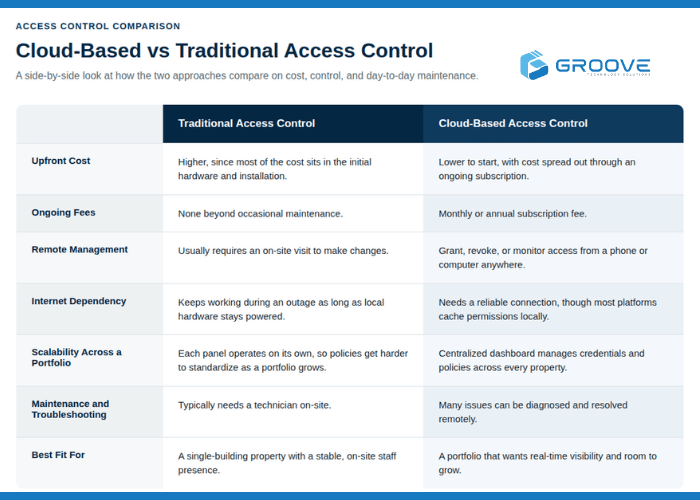
Staffing levels matter just as much. Properties with lean on-site teams benefit from the ability to grant or revoke access remotely, which cuts down on trips to a panel or a lockbox. Internet reliability plays a role too, since a property in an area with frequent outages needs to confirm how a cloud-based system handles a lost connection before committing to it.
Growth plans deserve consideration as well. An owner planning to add units, buildings, or entire properties in the coming years often finds it easier to standardize on a cloud-based platform from the start, instead of migrating a traditional system later.
More on Access Control Options – Traditional vs. Cloud-Based
In many cases, yes, since some cloud-based platforms work with existing door hardware and simply replace the panel and management software. A technician typically needs to assess the current wiring, readers, and locks first to confirm compatibility, since older equipment sometimes needs an upgrade alongside the software switch.
Most cloud-based access control systems keep working for a period during an internet outage, since they store basic permissions locally on the door hardware itself. Staff typically lose the ability to make real-time changes or view activity remotely until the connection returns, but residents and staff already granted access usually keep getting in.
Cloud-based access control works well in retrofit properties, particularly when paired with wireless locks and readers that avoid extensive new wiring. Older properties without existing low-voltage wiring for a traditional panel often find cloud-based systems easier and less disruptive to install than running new cable throughout the property.
Finding the Right Access Control Fit for Your Property
Traditional and cloud-based access control both keep a property secure, but they serve different priorities. Traditional systems suit properties that want a one-time investment and do not need remote management. Cloud-based access control suits properties that want real-time visibility, remote credential management, and the flexibility to grow across a portfolio, much like the shift video surveillance already made from centralized recorders to distributed, cloud-connected storage. Groove works with owner-operators to compare these systems as part of a broader access control solution, matching hardware and software to a property’s actual daily operations.
Our team works with hotels, senior living communities, multifamily properties, and other commercial properties across the country to figure out which access control setup actually fits their day-to-day operations. Groove’s ratings speak for themselves, and the Groove Guarantee backs every installation from planning through ongoing support.
If your property is weighing a switch to cloud-based access control, or simply wants a second opinion on what is already in place, reach out to Groove for a no-pressure conversation about what would work best for your community.