Get Grooven at a Glance
- The 2026 FIFA World Cup runs from June 11 through July 19, spanning 104 matches across 16 cities in the United States, Canada, and Mexico.
- Hotels in host cities are seeing meaningful occupancy and ADR growth, with markets like Los Angeles and New York tracking ADR above $400.
- The 2022 World Cup in Qatar drew 5 billion total media engagements globally, making it the most-watched sporting event ever broadcast.
- Hotels outside host cities still have a major revenue opportunity in fans watching on property, driving food and beverage spend, loyalty, and positive reviews.
- FOX and FS1 carry all 104 matches in English; Telemundo and Universo broadcast in Spanish – all available through DIRECTV for commercial properties.
- Hotels that ensure guests can watch every match, in rooms and in common areas, will outperform those that don’t during the tournament window.
- Groove can help hospitality properties add World Cup channels.
Your Hotel Has a World Cup Opportunity This Summer
The 2026 FIFA World Cup arrives on North American soil in a few weeks, and it is unlike any tournament the world has ever seen. With 48 competing nations and 104 matches played across 11 U.S. cities, 3 Mexican cities, and 2 Canadian cities, this will be by far the biggest sporting event of the decade.
For hotels in host cities like Los Angeles, New York, and Seattle, the impact has likely already been felt in forward bookings and rate strategy. But here’s the thing – you do not have to be in a host city for your hospitality property to win big this summer.
Every hotel in America has an opportunity to capitalize on this enormous event. The question is whether or not your property is set up to deliver that experience.
The 2026 FIFA World Cup Tournament Overview
The 2026 World Cup runs for 39 days, with matches spread across multiple rounds and venues. Here is the full schedule breakdown:
Group Stage: June 11 – June 27, with 72 matches across 16 cities. The Group Stage is the longest and most widely distributed phase of the tournament, with multiple matches running simultaneously each day.
Round of 32: June 28 – July 3, with 16 matches across 14 cities. The next round is action-packed, with some days featuring three or four matches.
Round of 16: July 4 – July 7, with 8 matches across 8 cities. Notably, Independence Day falls during this round, meaning several U.S. cities will host major games on July 4th, equalling a powerful combination for property occupancy.
Quarterfinals: July 9 – July 11, with 4 matches across 4 cities. These games are intense with heightened viewership.
Semifinals: July 14 – July 15 with 2 matches in Dallas and Atlanta. This round determines which teams will compete for the championship, making these some of the most-watched games of the entire tournament.
Third-Place Match: July 18 in Hard Rock Stadium, Miami. The battle for bronze, this game decides which nation gets to leave with a medal.
World Cup Final: July 19 in MetLife Stadium, New York. This is the biggest match in world soccer and will be the most-watched sporting event of the year.
The geographic spread of this tournament creates a unique opportunity across a much wider range of markets than any previous World Cup in history. To put it in perspective, the farthest stadiums for the World Cup 2022 held in Qatar were only 34 miles apart. The World Cup 2026 spans from Vancouver to Miami, from New York to Mexico City. Fans won’t have to be concentrated in a single city, instead moving between regions and booking travel around specific games.
What the Data Shows for Host City Hotels
The numbers behind this tournament tell a compelling story for hoteliers.
Increased Air and Hotel Bookings
According to a study from Amadeus Hospitality, “Football’s Biggest Event in 2026,” air searches and flight bookings to all 16 host cities have been accelerating as the tournament approaches. Looking at specific pre-match arrival windows, bookings to host cities ran approximately 26% higher daily in the June 8 through June 11 window compared to the prior year, with fans positioning in their host city ahead of opening kickoff. The June 12 through June 18 window followed at approximately 12% above prior-year daily levels, reflecting sustained fan travel through the first full week of Group Stage matches and the momentum that comes with weekend overlap.
While early booking trends came in softer than the most optimistic projections from late 2025, industry analysts have been clear that demand for this tournament is expected to concentrate sharply around match days and build through the knockout rounds. Prior major tournaments have shown a consistent pattern of a slower build in the early rounds followed by a strong surge as bracket stakes increase. This World Cup is tracking the same way.
Occupancy and ADR Trending Higher
Hotel occupancy and ADR trends tracked by Amadeus show month-over-month growth in host markets that GMs and revenue managers have been watching closely. Some examples of U.S. host city data include:
- Seattle is tracking double-digit month-over-month occupancy growth, with ADR levels above $300.
- Los Angeles is seeing double-digit month-over-month occupancy growth with ADR above the $400 mark.
- New York/New Jersey, the market that hosts the World Cup Final on July 19, is also running double-digit month-over-month occupancy growth with ADR above $400.
On the spending side, a joint FIFA and World Trade Organization economic impact assessment estimates that international attendees will stay an average of 12 days in the U.S., attend roughly two matches, and spend more than $400 per day. For hotels in and around host markets, that spending profile adds up quickly.
The Opportunity for Every Hotel
The broader story that often gets missed in coverage that’s focused solely on host city economics is the impact of the tournament on the rest of the country. Consider, for example, that the 2022 FIFA World Cup generated 5 billion total media engagements globally. That includes 2.9 billion linear TV viewers, 2.7 billion digital and streaming engagements, and 2.2 billion social media interactions.
These numbers represent the largest audience ever assembled around a single sporting event. And with the 2026 tournament played during convenient times in this hemisphere, matches in familiar cities, and coverage in English and Spanish on major broadcast networks, the domestic viewership and engagement figures are expected to surpass Qatar significantly.
How does your hotel take advantage of the kinds of opportunities the World Cup is bringing? First of all, your guests are going to want to watch these matches. Whether they are business travelers who happen to be out of their meetings during a match, families on summer vacation who want a TV sports break, or fans who planned their trip specifically around the tournament, the World Cup viewing experience should absolutely be available as part of their stay. Restaurants and bars set up to show the games will drive food and beverage revenue. Lobbies with well-placed displays will create energy and community. And in-room entertainment that reliably delivers the broadcast will build the kind of satisfaction that shows up in reviews.
How to Watch the World Cup at Your Hotel
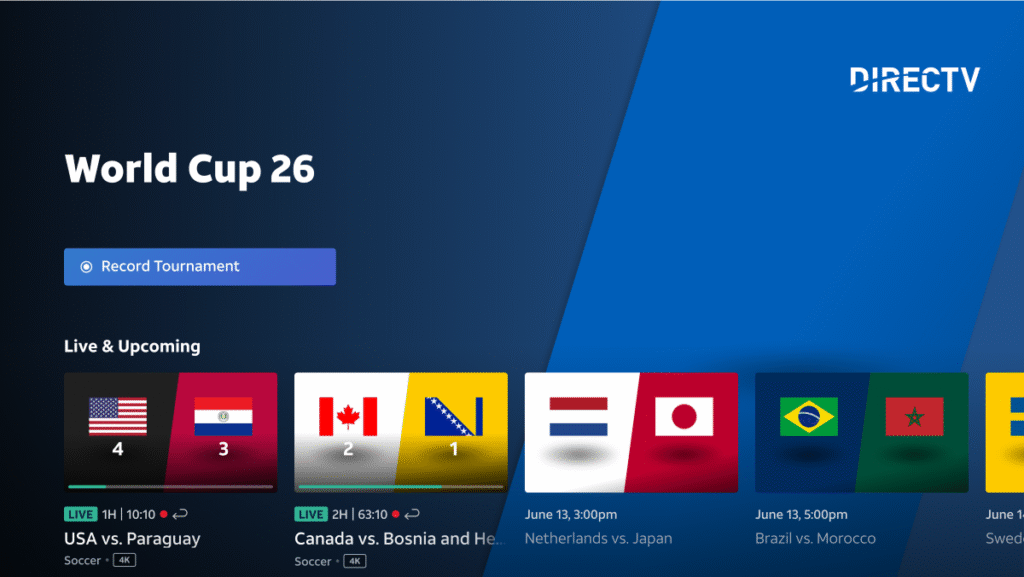
In the United States, World Cup television coverage is from two broadcast groups:
English-Language World Cup 2026 Coverage
FOX Sports holds the exclusive English-language rights for all 104 games. FOX will air 70 matches while FS1 will run the remaining 34. DIRECTV carries FOX (local) and FS1 across its plans, with FS1 available on channel 219. FOX is a local broadcast channel, so the channel number will vary depending on your property’s market and provider.
Spanish-Language World Cup 2026 Coverage
Telemundo will broadcast 92 matches in Spanish, making it one of the most accessible options in the country. Universo, Telemundo’s cable partner, will air the remaining 12 matches. Telemundo is delivering more than 700 hours of World Cup programming, the most extensive Spanish-language World Cup broadcast in U.S. television history. For hotels serving Spanish-speaking guests or located in markets with large Spanish-speaking fan bases, having Telemundo and Universo available will be a meaningful differentiator.
The Bottom Line for Your Hotel
DIRECTV for commercial hospitality properties carries the full suite of World Cup channels, including FOX, FS1, Telemundo, and Universo. Therefore, signing up with DIRECTV Hospitality is the most straightforward path to ensuring your hotel has complete coverage from the opening match in Mexico City on June 11 through the Final at NYC MetLife Stadium on July 19.
If you haven’t confirmed your channel lineup yet, there is still time to act. The knockout rounds, including the Quarterfinals, Semifinals, and the Final on July 19, draw the largest audiences and generate the most in-property demand. Getting set up now means your property is ready for the matches that matter most to your guests.

Setting Your Property Up for World Cup Success
Confirming your channel package is the first step. Here are some additional tips to make sure your hotel maximizes on this once-in-a-generation opportunity:
Use Common Areas as Revenue Drivers
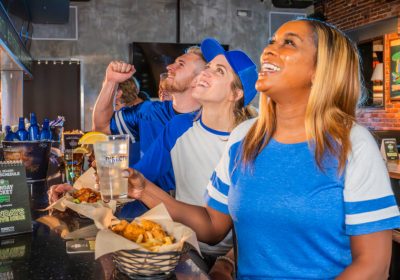
Hotel restaurants, bars, and lobbies with reliable, well-positioned displays will generate meaningful food and beverage revenue during match windows. Fans who can watch a game at your property are spending money at your bar and tables for hours instead of having to leave to find a screen somewhere else.
Display Quality Matters
A game broadcast on a small or poorly calibrated screen does not deliver the experience fans are looking for. Consider the display quality, positioning, and audio in your common spaces before the tournament begins.
In-Room Entertainment Should Be Consistent
Guests who cannot find the match from their room will call the front desk, and if the problem is not resolved quickly, that frustration ends up in a review. Managed in-room entertainment that reliably delivers FOX, FS1, Telemundo, and Universo will remove any friction before it happens.
Staffing Around Match Windows
The World Cup match schedule runs through the morning and afternoon in U.S. time zones. Therefore, make sure to review the match schedule against your current staffing plan. High-traffic common area windows during match times may require additional coverage.
Digital Signage as an Engagement Tool
Displaying match times, upcoming fixtures, and score updates on your property’s digital signage creates touchpoints that keep guests engaged and encourage them to stay on site for the next match.
Get Your Property Ready Before Kickoff
The 2026 FIFA World Cup is an incredible event on our own home soil. Whether your property is in one of the host cities or not, the opportunity to deliver a standout guest experience during the tournament window is there for you to take.
Groove works with hotel properties nationwide to design, install, and manage the hospitality technology that makes experiences like this possible. From DIRECTV channel packages that cover every World Cup match to in-room entertainment streaming systems and common-area AV solutions, our team is here to ensure your property is ready.
Connect with Groove today to prepare your hotel for the world’s biggest tournament!