
Choosing the right multifamily internet provider seems straightforward. But make the wrong call, and you could be living with it for a long time. Here’s what every owner-operator should know before signing anything.
Wireless Connectivity Needs and the Infrastructure It Depends On
As an MDU owner-operator, you’ve probably noticed a shift in technology expectations recently, with prospective renters asking more questions than ever about the tech at your property. To keep up with the demand, your management incorporates the technologies residents want, and after investigating the properties and costs, you invest in solutions, anticipating that the payoff is worth it in resident satisfaction.
But here’s what often gets overlooked: every piece of smart technology in your building is only as reliable as the network running beneath it. Smart thermostats, keyless entry, leak detectors, access control, parking surveillance – all of it depends on your Wi-Fi infrastructure to function.
Modern networks need to carry:
- Resident internet in every unit
- Leasing office operations with multi-gigabit capacity
- Video surveillance in parking areas and common spaces
- Common area connectivity that actually performs
- IoT devices that need to stay connected around the clock
Get the network right, and your technology investment pays off. Get it wrong, and even the best smart amenities will underdeliver.
Planning for an Upgraded Wi-Fi Network
As multifamily properties modernize, planning your upgraded network is about long-term adaptability and performance. Properties should focus on:
- Designing for flexibility and scalability so networks can evolve without a major rework
- Building a strong multi-gig backbone to support growing bandwidth demands
- Preparing for IoT devices and smart amenities that rely on consistent connectivity
- Ensuring the electrical infrastructure can handle increased power requirements
Just as important as infrastructure planning is timing – especially when it comes to contracts.
Your Contract Window Matters More Than You Think
Your ability to upgrade or switch MDU internet providers often comes down to timing:
- Mid-contract, your options are limited
- As contracts near expiration, providers move quickly to lock in renewals
- Missing this window can mean being tied to outdated technology for years
Before signing with any multifamily internet provider, ask:
- Ownership – Who owns the infrastructure and equipment at the end of the contract?
- Status – Does the network stay active during unit vacancies, or does it shut off?
- Price – Is pricing truly fixed, or are annual increases built into the agreement?
- Integration – Will the solution integrate with your Property Management Software (PMS) or require manual management?
- Support – What does the customer service look like – U.S.-based and responsive, or ticket-based and delayed?
These considerations will directly impact your NOI, resident experience, and long-term asset value.
Warning: “Free Infrastructure” Isn’t Free
Something every owner-operator should be aware of is that when a cable company offers to install infrastructure at no cost, they own that cabling and equipment. That means:
- You’re secured into their service contract for as long as that infrastructure is in your building
- If performance suffers, your leverage is essentially zero
- If you want to upgrade, switch providers, or modernize your network, you could be facing a costly infrastructure overhaul
For owner-operators already dealing with resident internet complaints and looking to make a change, this can be an especially frustrating position. Owning your infrastructure keeps you in control, giving you the flexibility to adapt, upgrade, and choose what’s best for your property over time.

Wi-Fi Solutions Available to Multifamily Properties
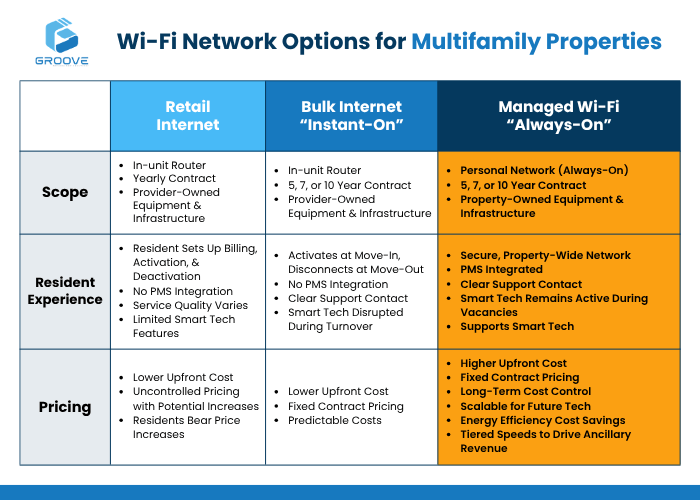
When you start talking to MDU internet providers, every option you’ll encounter fits into one of three categories. Understanding the difference is one of the most important things you can do before entering any conversation with a provider.
Retail Internet
With retail internet, the provider installs the infrastructure, owns the equipment, and each resident signs their own contract. You have no control over pricing, service quality, or the resident experience. Annual rate increases are standard, there’s no PMS integration, and if you ever want to make a change, you’re working on their timeline and their terms.
Bulk Internet – “Instant-On”
With bulk internet, the property typically does not own the infrastructure or equipment, internet is bundled into the lease, and pricing is fixed for the contract term. PMS integration is generally not included. This “instant-on” model sounds appealing until you realize that “instant-on” also means “instant-off.” When a unit goes vacant, the connection cuts out. Smart locks, thermostats, and sensors go dark. For owner-operators managing vacancy periods and turnover operations, that’s a real problem that compounds quickly.
Managed Wi-Fi – “Always-On”
With managed Wi-Fi, your property owns both the infrastructure and the equipment. The system is “always-on” through vacancies, turnovers, and lease-ups. Residents connect to a secure Personal Area Network (PAN) for secure property-wide coverage. The model typically includes PMS integration, fixed contract pricing, and a network backbone that supports current smart amenities and future expansion.
Why Managed Wi-Fi Is Gaining Traction in MDUs
Managed Wi-Fi is quickly becoming the standard for forward-thinking properties for a number of different reasons:
1. Always-On Connectivity
Unlike bulk or retail models, managed Wi-Fi ensures the network is always active, supporting both residents and building systems at all times.
2. Seamless Resident Experience
Residents can move throughout the entire property without losing connection.
3. Stronger Security
A personal area network reduces security risks compared to shared networks.
4. Smart Technology Enablement
From smart locks to energy management systems, managed Wi-Fi provides the backbone needed to run connected amenities reliably.
5. Operational Efficiency
Vacant units remain connected, allowing for:
- Remote monitoring – get notified if a water leak happens or AC goes out
- Energy management – reduce thermostat settings to optimize energy savings during vacancies
- Faster turn times – a well-maintained unit can be quickly prepped for new tenants
A Revenue Stream Most Owner-Operators Aren’t Capturing
One of the more compelling reasons properties are moving toward managed Wi-Fi is the ancillary revenue opportunity it creates. When internet is bundled like a utility, many MDU properties incorporate a technology fee to offset the cost of this service. Research on resident demand for technology amenities suggests that prospective renters are willing to pay these fees when they perceive clear value in return.
In addition, you can offer tiered speed packages, with standard speeds included in rent and premium tiers available for residents who want more. Remote workers, heavy streamers, and gamers opt up willingly, generating additional income per door without adding overhead.
This model also addresses a common resident concern about bundled internet: “What if I need faster speeds?” The tiered approach gives residents the flexibility, reduces friction at lease signing, and gives residents one less reason to leave.
Retrofitting: A Practical Path Forward
Upgrading doesn’t always mean starting from scratch. The key is working with a multifamily internet provider who will assess what you already have and build intelligently around it.
The right MDU internet provider can:
- Reuse existing wiring where possible
- Retrofit access points and network hardware
- Integrate G.hn technology, which uses existing coaxial or phone line wiring to deliver broadband without major renovations
When designed with flexibility in mind, retrofitting is far more cost-effective than future overhauls.

What to Look for in an MDU Internet Provider
Not every provider that sells managed Wi-Fi can support it over the long haul. For owner-operators or property management groups making a multi-year commitment, that distinction matters enormously.
Here’s what to look for in an MDU internet provider:
Long-Term Support Well After Install
Some integrators are strong at deployment but hard to reach once the system is live. Look for a partner who remains accountable in year three, year five, and beyond.
US-Based Support 24/7
When a resident has a connectivity issue, response time matters. Look for providers with in-house US-based support and field service teams available around the clock instead of offshore ticket queues with slow resolution times.
Multifamily-Specific Experience
Managing Wi-Fi for an apartment community is different from wiring an office building. Your provider needs to understand occupancy cycles, PMS integration, resident-facing service, and the real operational demands of running a modern community.
Honest Assessment of Existing Infrastructure
A trustworthy partner evaluates what cabling and systems you already have and finds ways to work with them – not just sell you more than you need.
Competitive, Transparent Pricing
Pricing for managed Wi-Fi varies by region and by what fiber and carrier options are available in your market. A good provider will go to market on your behalf to secure the best available bulk-rate pricing.

Why We Built Groove Around These Principles

“Price is important. But having a provider who is there for the long-term matters just as much. The right provider is a company that’s built the experience, support infrastructure, and tailored resources to stand with you over time, not hand you the keys and walk away.”
– Nate Sundloff, V.P. of Multifamily Sales
If you’ve read this far, you already know what separates a strong managed Wi-Fi partner from one that installs a system and disappears. At Groove Technology Solutions, these are the standards we’ve built our business around.
Here’s what that looks like in practice:
- Always-on infrastructure that stays active through vacancies and turnovers
- U.S.-based support available 24/7 from in-house teams, not outsourced ticket systems
- PMS integration and fixed pricing built into every contract
- Retrofit-friendly deployment using G.hn technology to minimize renovation costs
- A partnership with Della OS, the property technology platform Groove integrates with for PMS and smart building management
We also go to market on your behalf to secure competitive bulk-rate pricing so you’re not locked into whatever a single carrier decides to charge.
If your contract is coming up for renewal or if you’re dealing with resident complaints and want to understand your options, we’re happy to start with an honest assessment of your current infrastructure, no commitment required.

