How Interoperability Can Make or Break Your Building’s Smart Technology
You’re a building manager who needs to make some changes in order to keep costs low and resident churn down. With so much talk about “modern apartment” living, you explore some smart technology features that seem like they could help. After a few years of piecing together different products and installing them in your building, however, you’re not seeing a ton of improvements. Instead of seamless operations, your staff is still spending significant time managing these smart systems. The maintenance chat still requires constant monitoring, not to mention all the other apps and programs you’ve implemented. Residents constantly experience issues across multiple platforms, from login errors to missed system alerts or notifications that never reach the right person. And you’re wondering why in the world you invested in this “technology” that, on paper, promised to be a game-changer, but in practice, has created a new set of inefficiencies.
We’ve reached a turning point in property technology when it comes to smart buildings. Why? Because “smart building” is still viewed as a collection of many disparate systems and apps that don’t talk to each other, but when used the right way, can be so much more.
It’s time to rethink what a smart building really is. In this article, written in collaboration with Groove’s Smart Building Technology Engineer, Mitchell Shearer, we’ll redefine smart building technology, explore the costs associated with implementation, and ultimately, determine what smart building tech could mean for your property’s future.
Redefining What A Smart Building Is
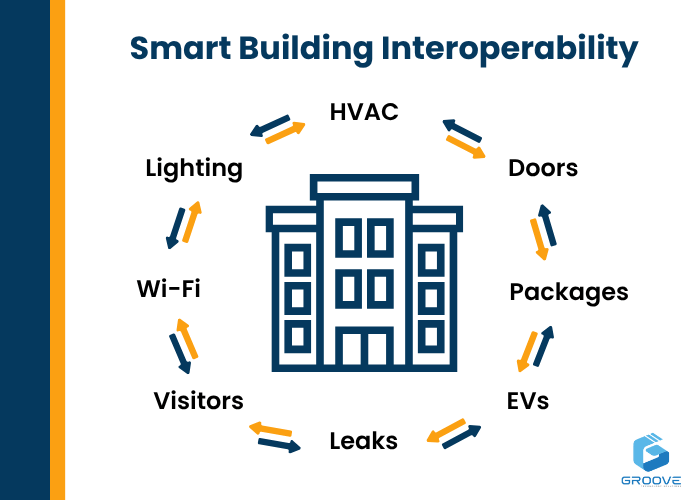
Smart building technology is a misunderstood concept in the proptech industry. All too often, it’s treated as a product, upgrade, or add-on feature. But smart building technology is about creating a cohesive ecosystem that turns hardware into intelligence, not simply installing a bunch of new devices. Every component, from access control and Wi-Fi infrastructure to in-unit devices, should work through a shared digital backbone that unites building management, resident experience, and operational efficiency. This concept is known as interoperability, and it’s the difference between a true smart building and one that’s not. With interoperability, every technology within a property communicates and operates together, as well as has the ability to build off the functions of one another.
“Ultimately, a smart building should be defined as the experience of unifying all property technology solutions together so they can all work in cohesion in the same environment. Smart building, at its core, is an idea that a building can be designed with many different technology stacks, but they all communicate together and are connected and controlled under one unified platform. ”
– Mitchell Shearer, Smart Building Technology Engineer, Groove Technology Solutions
A truly smart building behaves as an integrated network. A thermostat communicates with door sensors to save energy when units are vacant. Parcel systems sync with building access to grant timed delivery access. Video entry phones, Wi-Fi infrastructure, and access control systems share one authentication layer. Each function reinforces the other. The result is not just a connected building, but a coordinated one.
Technical Debt – What Is It and Why Is It Essential
Beyond the headaches and hassles of using multiple systems that don’t communicate with each other, without true smart building adoption, you also risk operational inefficiencies that can impact your bottom line. All too often, technology is chosen based on two simple criteria: does it solve the most pressing issue, and is it the lowest possible cost? While that logic might seem practical in the moment, it overlooks the broader picture of how the technology will serve, scale, and integrate over time.
The term “technical debt” is the unseen cost of fragmented decisions. It’s what happens when systems don’t work well together and short-term solutions create long-term inefficiencies. For instance, imagine a property that invests $10,000 in a smart lock system and another $10,000 in a leak detection system – two separate systems with separate logins and user interfaces that don’t integrate with each other. Meanwhile, a single, interoperable platform exists that could provide both features for $15,000. While the $5,000 difference represents the company’s immediate technical debt, the full technical debt goes beyond the initial expense. Over time, that debt grows through higher maintenance costs, redundant software fees, staff frustration, and lost time spent juggling disconnected systems. Ultimately, technical debt encompasses both financial loss as well as any operational inefficiencies, now and in the future.
Reducing technical debt requires a shift from a product-by-product mindset to one of interoperability and strategic integration of your systems. Technology is expensive, but there’s no saving in mistakes that must later be undone. Every unplanned component becomes a future liability that drains time, capital, and trust.
That’s why procurement should be driven not by price, but by purpose.

The Real Cost Of Smart Building Technology
The cost of installing smart building features varies widely depending on factors like location, building makeup, existing infrastructure, and the specific smart systems being implemented. Therefore, pinpointing a range of prices is incredibly difficult; however, to showcase how investing in smart building tech is worth it, we’ll use an example.
Let’s consider a standard 100-unit apartment building. A full installation covering everything from street to suite might run around $350,000. Sticker shock can make property teams shy away from a full-scale system, leading them to choose less expensive, single-use smart features, totaling around $250,000. On the surface, this seems like a $100,000 savings, but without interoperability, you end up paying additional costs in the long run.
The true cost of smart technology isn’t what you pay upfront. It’s how well the system performs, integrates, and endures over time. Many properties make decisions based on initial price, only to find that fragmented systems create inefficiencies and hidden burdens.
A truly integrated ecosystem delivers value through alignment and performance. When systems communicate and automate across access, connectivity, energy, and resident experience, the building works as one cohesive organism. Integrated systems deliver measurable advantages through:
Energy Optimization
With smart building interoperability, properties typically see a 25-30% reduction in energy costs due to the energy efficiency capabilities of the systems adapting to their occupants.
Preventative Protection
Leaks that go undetected and mold concerns can run thousands of dollars in property damage and remediation fees. Smart monitoring minimizes risk and extends the life of your assets.
Scalable Infrastructure
The energy efficiency gained from smart building technology often means your property can operate with smaller boilers or less powerful HVAC systems. For example, selecting lower-BTU units can reduce upfront equipment costs by 10–15%, resulting in thousands of dollars in savings.
When you consider these scenarios, smart building technology pays for itself and then some. Fragmented solutions may appear cheaper, but they introduce complexity and cost. Unified systems deliver stability, consistency, and long-term value. Many industry leaders argue that skipping an interoperable smart system is financially irresponsible, given the measurable efficiency gains and protections it provides vs the cost of technical debt and resident/user satisfaction.
The Wow Factor of Smart Building Technology
In addition to tightening up technical debt and operational efficiency, smart buildings have a wow factor that appeals to residents, guests, and management. The smartest buildings aren’t defined by their devices but by the experiences they enable. Safety, comfort, and convenience arise when every layer interacts seamlessly.
“Think of safety concerns for residents. Smart building technology allows someone to swipe a credential on a card reader. The system can communicate with the camera located near the card reader to automatically record the person at the door. The resident can allow or not allow entry based on the video. Normally, an access control software and camera software would never be able to communicate together. This type of safe access is a huge perk, especially for students, women, and seniors.”
– Mitchell Shearer, Smart Building Technology Engineer, Groove Technology Solutions
Imagine a resident tapping one credential that unlocks doors, connects to cameras, and logs an access event – or signing into Wi-Fi once to control their thermostat, lighting, locks, EV charging, and parcels, all from one interface. These aren’t futuristic luxuries. They’re the new standard of smart living.
Spotlight On Della OS
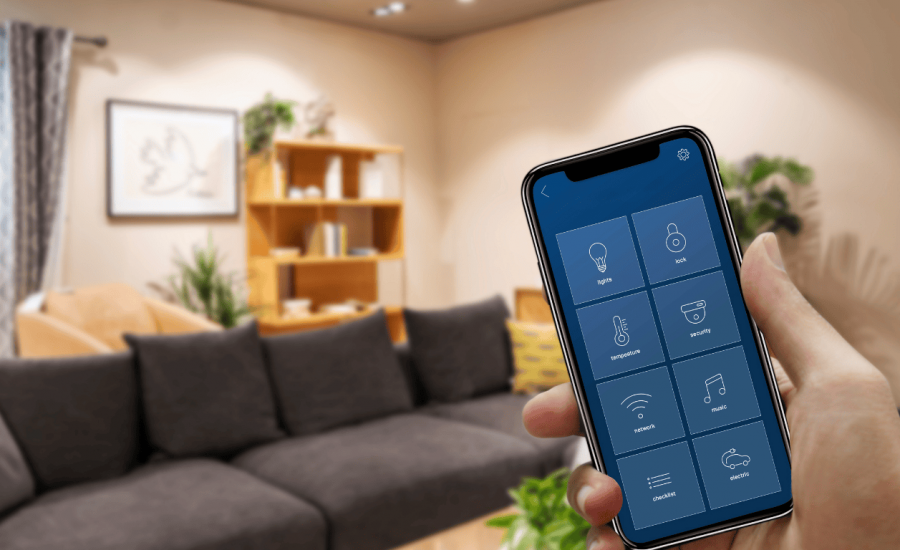
In addition to logging on once for all systems, a standout feature of smart building capability is the ability to see all of a building’s smart devices on one user-friendly app. Controlling every single smart function under one login and one system is a highly valued amenity for both residents and property managers. Della OS is designed specifically for smart building technology integration. The Della Resident App elevates the living experience with easy, seamless controls and features. Residents have the ability like they’ve never had before to control technology in their own apartments and living spaces.
For property teams, the capabilities of the Della Connect interface are just as impressive. Maintenance requests become fully automated, assigning technicians with photos, notes, and status updates without any manual tracking. Managers can view every unit’s systems in real time, generate energy usage reports, and recode smart locks, all from a single dashboard. Units can be placed in eco or vacancy modes, drastically cutting energy costs and preventing issues like mold.
A Strong ROI for Smart Building Technology
Communities with a true smart living system like Della OS see higher resident satisfaction and stronger retention. When technology enhances comfort, safety, and convenience, residents are more likely to stay longer. To illustrate, according to a study done by Parks Associates, 39% of MDU residents considered property-provided smart home devices a key differentiator when in the market for their next apartment. The same study found that smart solutions commonly had a three-year payback period, and either were a necessary amenity for residents or would result in a lift to rent ranging from 5 – 10%. In other words, smart technology directly improves NOI and ROI through reduced expenses and lower resident churn.
These are the hidden strengths of a well-designed smart building: a system that quietly works behind the scenes to save money, streamline operations, and deliver a next-level experience that residents and property managers love, and are starting to expect from properties.
Designing for Interoperability
Smart building success starts in design, not after construction. When technology is an afterthought, inefficiencies multiply. Planning for interoperability from day one ensures every system – access, CCTV, lighting, HVAC, and unit devices – operates as the foundation that allows everything else to perform at its best.
By selecting compatible products and technologies from the outset, a building can be designed so every system works together seamlessly. From there, the possibilities are endless. A property could incorporate and integrate a number of smart capabilities, including managed Wi-Fi, smart locks, door and window sensors, intercoms, EV charging stations, parcel management systems, cameras, access control, leak detection, smart lighting, automated blinds, video entry systems, and thermostats – all carefully chosen to operate together under a single digital ecosystem.
This unified framework enables:
- Consistent standards
- Real-time data across portfolios
- Secure, role-based access
- Automated workflows
- Scalable, future-ready operations
When all components are planned and implemented cohesively, the result is a building that’s not only efficient and easy to manage but also one that delivers a superior experience for residents from day one.
Take the Next Step Toward True Smart Building Tech
While traditional property management software focuses on finances, smart building systems focus on how people move, live, and connect. This adaptive ecosystem gives property teams real-time control over building operations while simplifying day-to-day management.
Across multifamily, hospitality, senior living communities, and commercial sectors, the opportunity is the same: stop managing technology as separate tools and start designing it as one system. By approaching smart building design with interoperability in mind from the start, properties can finally move past fragmented systems and fully realize the promise of a connected, efficient, and elevated environment for both operators and occupants.
Groove Technology Solutions is helping shape that future by redefining what true smart building technology can achieve. To learn how interoperability can transform your properties, reach out to Groove today.